
Local TV news hands every viewer a free seminar in self-government. Nexstar’s 41 debates and forums this cycle show that civic classroom at scale.
Sustaining a Free Society
Democracy starts close to home, and so does its best classroom. When a local TV station puts local politicians under the lights, it hands every viewer a free seminar in self-government. No tuition, password or paywall required.
University of North Texas professor Valerie Martinez-Ebers should know. A Latino politics expert, she’s tracked how local TV news reports uncover abuses impacting communities of color. “School board decisions, utility outages, redlining’s lingering effects—none of these would reach minority audiences as well without local television news.”
President John F. Kennedy understood the stakes.
Speaking at San Diego State College in 1963, he warned that “no free society can possibly be sustained, unless it has an educated citizenry.”1 Citizens “exercise the ultimate power,” he said, and they wield it every time they choose a leader. President Ronald Reagan returned to that responsibility in his farewell address in January 1989. “An informed patriotism is what we want,” he said. National pride would not endure, he warned, unless it was “grounded in thoughtfulness and knowledge.”2
And action. Martinez-Ebers offers:
“To complete the virtuous cycle of democracy, information must lead to thought and thought to participation, culminating with the vote.”
– Dr. Valerie Martinez-Ebers, University of North Texas and President-elect, American Political Science Association
Passivity to Participation
Local TV journalism puts this cycle in service. It helps citizens understand the institutions they share, question the people who lead them, and judge the choices before them. A televised hometown debate makes self-government something viewers can examine and practice.
The research backs that claim. Residents who receive in-state local television news know more about their governors and senators and split their tickets more often.3 When television spread across 1950s Canada, turnout fell where stations carried only national fare but held steady where they aired local news.4 The reverse holds too. As local newspapers cut campaign coverage, knowledge and participation fell.5
Debates deliver that information in its purest form.
Candidates answer live questions, face their rivals, and stand accountable before the neighbors who will hire or fire them. Every exchange teaches civics in real time and turns passive audiences into informed participants.
Edward R. Murrow saw this possibility in 1958. Television, he told the nation’s news directors, could “teach” and “illuminate,” but only if people chose to use it that way. “Otherwise it’s nothing but wires and lights in a box.”6 Murrow feared a medium built to “distract, delude, amuse, and insulate us.” Hometown debates answer that fear. They swap distraction for substance and hand citizens the “sufficient undiluted information” his speech called the premise of a pluralistic society.
On debate night, the box finally does what Murrow asked of it.
Federal law anticipates this work. Broadcasters hold their licenses to serve “the public interest, convenience, and necessity,”7 and Congress preserved their duty to air “conflicting views on issues of public importance.”8
Illumination in Action: Nexstar Media’s Civic Classrooms
Nexstar Media Group shows that mandate at scale. Its stations and partners reach 116 of the nation’s 210 television markets and roughly 70% of U.S. TV households.9 This cycle, they committed to 41 debates and forums,10 from U.S. Senate showdowns to an Onondaga County sheriff’s race that gave voters its only televised debate.11
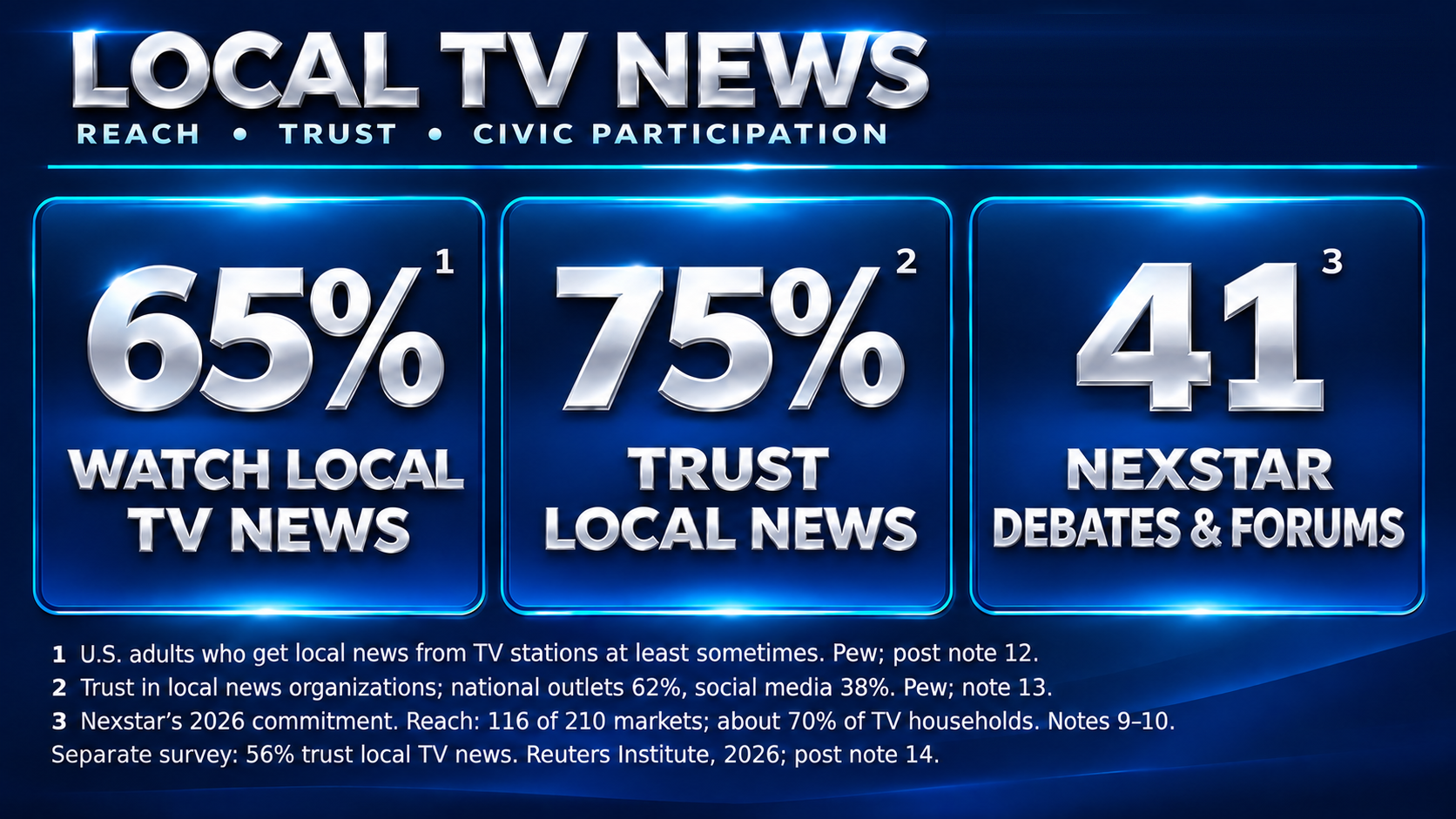
Reach and reputation seal the argument. Sixty-five percent of U.S. adults get local news from TV stations at least sometimes.12 Three in four trust local news organizations, compared with 62% for national outlets and 38% for social media.13 The Reuters Institute’s 2026 Digital News Report puts trust in local television news at 56%, above every national brand it measured.14
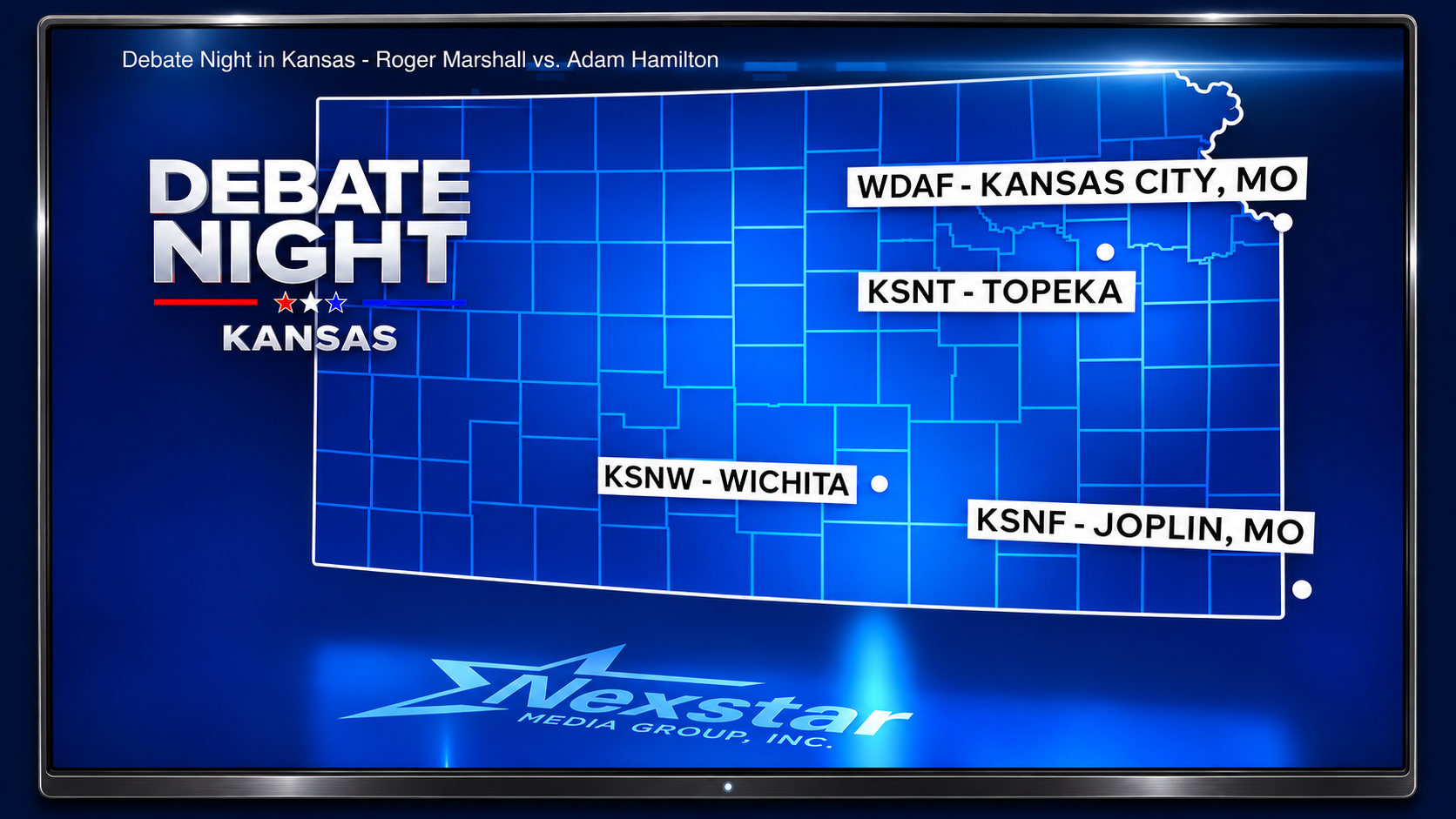
Courtesy of Nexstar Media Group
Debates test the candidates, too. latakoo Co-founder and CEO Paul Adrian explains:
“You can measure the power of debates, in part, by seeing who is willing to participate and who isn’t.”
– Paul Adrian, Co-Founder and CEO, latakoo
Adrian offers a case in point: “In Texas, neither Governor Greg Abbott nor Attorney General Ken Paxton agreed to debate their opponents, even though Gina Hinojosa and James Talarico each accepted at least four debate invitations. Instead, their campaigns and supporters spent enormous sums on political advertising. Think about the irony: candidates are willing to pay television stations millions of dollars to deliver their carefully crafted messages to voters, but unwilling to appear on those same stations to answer questions they don’t control. That’s precisely why debates matter. Advertising allows candidates to tell voters what they want them to hear. Debates give voters an opportunity to hear what they need to know.”
Reagan gave a hyperlocal perspective in his farewell: “All great change in America begins at the dinner table.”2 Local television can give that conversation substance. A family watches the candidates, weighs their answers, and talks about what its community needs. The station brings the debate home. The citizens decide what comes next.
Streaming services charge subscriptions. Social feeds reward outrage. Broadcast television asks only for an antenna. A retiree on a fixed income and an executive in a corner office receive an identical debate at the same moment. No other medium matches that blend of reach, trust, local focus and open access. For civic education, broadcast television, bar none, shines the brightest light on our democratic ideals.
Notes
- John F. Kennedy, “Commencement Address at San Diego State College,” June 6, 1963, The American Presidency Project, presidency.ucsb.edu.
- Ronald Reagan, “Farewell Address to the Nation,” January 11, 1989, Ronald Reagan Presidential Library and Museum, reaganlibrary.gov.
- Daniel J. Moskowitz, “Local News, Information, and the Nationalization of U.S. Elections,” American Political Science Review 115, no. 1 (2021): 114–129, doi.org/10.1017/S0003055420000829.
- Mathias Bühler and Andrew Dickens, “National Content and Local Political Consequences: Evidence from Public and Private Television,” Journal of Public Economics 259 (2026), sciencedirect.com.
- Danny Hayes and Jennifer L. Lawless, “The Decline of Local News and Its Effects: New Evidence from Longitudinal Data,” Journal of Politics 80, no. 1 (2018): 332–336, doi.org/10.1086/694105.
- Edward R. Murrow, address to the Radio-Television News Directors Association, Chicago, October 15, 1958, American Rhetoric, americanrhetoric.com.
- 47 U.S.C. § 309(a).
- 47 U.S.C. § 315(a).
- Nexstar Media Group, Form 10-K for fiscal year 2025, figures as of February 2026.
- Nexstar Media Group, “Nexstar’s Local Television Stations To Host and Air 41 Live Candidate Debates Prior to Midterm Elections,” September 29, 2026.
- Nexstar Media Group, “Political Debates Coverage,” 2026.
- Pew Research Center, “Local News Fact Sheet,” survey of December 8–14, 2025, pewresearch.org.
- Pew Research Center, “Americans’ Trust in Information From News Organizations Has Risen in the Past Year,” November 2, 2026, survey of 5,193 U.S. adults, September 14–20, 2026, pewresearch.org.
- Reuters Institute, Digital News Report 2026, as reported by Newscast Studio, June 18, 2026.
About the Author
Brian Calfano, Ph.D., serves as Director of Film Partnerships and a latakoo sales rep. A political scientist with over 100 peer-reviewed publications, he has also earned 26 local and regional journalism awards, including a New York Emmy nomination. He directed John Johnson Reporting, narrated by Whoopi Goldberg as well as Al Primo & His Eyewitness News Revolution. Calfano leads We Choose Media, LLC, his documentary production company.
About latakoo
latakoo is a mission-critical, cloud-based, secure video workflow platform trusted by some of the world’s largest broadcasters, media and production companies, and content creators. Founded by journalists and built for high-pressure professional environments, latakoo delivers a fast, secure way to move, manage and share video from anywhere to anywhere, regardless of bandwidth, distance or location. Headquartered in Austin, latakoo is reshaping how video is captured, transferred, managed and understood across media, production, sports, government and defense.
Other Articles
“Did that really happen to me?”
After working on Generative Video Codec for more than a decade, latakoo’s scientist Richard Metzler was stunned to win NAB’s top Tech Award 2025….
5 Best Alternatives to WeTransfer
Learn about the best WeTransfer alternatives. Get a comprehensive assessment and practical insights to help you choose an alternative to WeTransfer.
Coming soon to a videocamera near you
Get ready for new technology that sharpens critical moments in real time, letting you see what matters first. We call it Generative Video Codec…